


Why Nigerian Parents Struggle With Raising Kids (And What Is Quietly Failing Us)
March 31, 2026
How to Make Money Online in Nigeria (Beginner’s Step-by-Step Guide That Actually Works)
April 1, 2026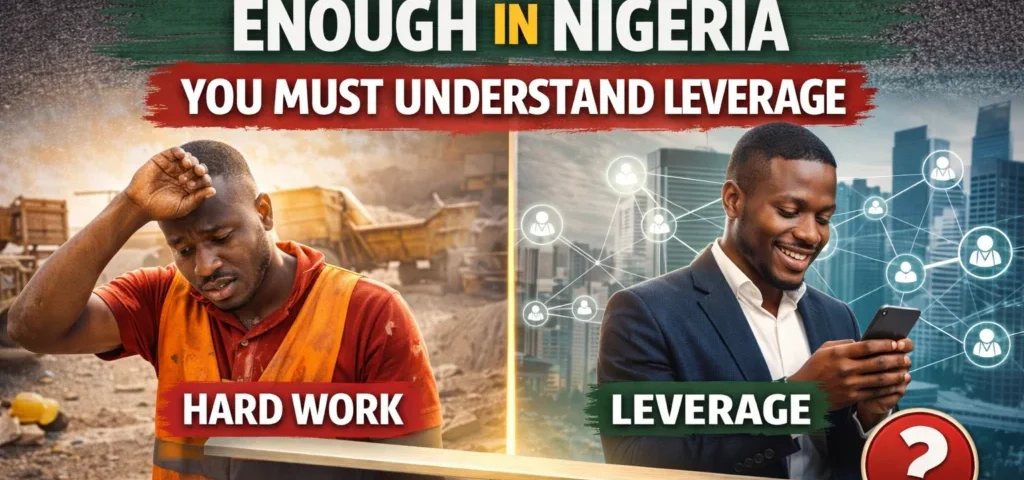
Hard Work Is Not Enough in Nigeria Anymore.
Here Is the Truth Every Parent Needs to Hear.
Let me tell you about my uncle.
My uncle, Uncle Emeka woke up at 5am every day for thirty years. He was a civil servant. He never missed work. He never took shortcuts. He never collected a bribe. He sent his children to schools, paid his rent on time and genuinely believed that if you worked hard and kept your hands clean Nigeria would reward you.
Last Christmas I watched him sit quietly at the family table and tell nobody in particular that his pension could not buy a bag of rice anymore. His voice was not angry. It was something worse than angry. It was confused. Like a man who followed all the rules and still somehow lost the game.
If that story sounds familiar it is because it is not just my Uncle Emeka's story. It is the story of millions of Nigerian parents right now in 2026. People who did everything right and still wake up every morning wondering how they are going to manage.
And here is the part nobody wants to say out loud. If you are still raising your children with the same belief system your own parents used — work hard, get good grades, find a good job, and everything will be okay — you may be setting them up for the same quiet confusion my Uncle Emeka had at that Christmas table.
This is not a comfortable post. I promise it is an honest one.
"A decline in inflation only means prices are rising more slowly.
It does not mean life has become affordable."
The Economy Your Children Are Growing Up Into Is Not the One You Were Promised
Here are the numbers as they actually stand in 2026. Not the government version. Not the press release version. The real version that shows up when you go to the market.
PwC released a report at the start of 2026 that should have been front page news in every household in this country. It said that even though inflation is technically slowing down, poverty is still getting worse because wages are not keeping up. In plain terms: prices went up very fast and even though they are not rising as fast anymore, your salary never caught up with where prices already are. You are still behind. You may always be behind if nothing structurally changes.
The World Bank confirmed the same thing. About 141 million Nigerians living below the poverty line in 2026. And here is the part that should make every parent pause: many of these people are working. They are not lazy. They are not idle. They wake up and go somewhere every day. They are just working in jobs so informal, so underpaid, so unprotected, that working hard is genuinely not enough to escape poverty anymore.
🔴 The hard truth: Only 11 to 15 percent of employed Nigerians hold actual wage jobs with any kind of protection or structure. The rest are hustling in the informal economy. Even among those with wage jobs, less than half have written contracts. Your child could graduate with a degree, work every day and still be financially vulnerable because the system that was supposed to reward hard work has quietly stopped working that way for most people.
What This Means for You as a Nigerian Parent Right Now
I am not writing this to make you feel hopeless. I am writing this because the parents I respect most in this country are the ones who see clearly. The ones who do not console themselves with half-truths while their children grow up unprepared for the actual world waiting for them.
The parenting challenge in Nigeria in 2026 is not just the usual discipline wahala or whether your child is spending too much time on TikTok, though those things matter too. The bigger, quieter challenge is this: how do you raise a child who will genuinely thrive in an economy that is structurally difficult, unpredictable, and does not automatically reward effort?
Because that is the economy they are going to inherit. Not the one we were promised in secondary school. The real one. The one where your cousin got a first class degree and spent two years sending CVs before something came through. The one where a graduate's starting salary in many companies cannot cover rent and feeding in Lagos simultaneously. The one where your neighbour started a small business not because she was entrepreneurial by spirit but because employment simply was not coming.
The Discipline Problem Nobody Is Talking About
Here is something I have noticed in conversations with parents across Nigeria. When the economy gets harder, parenting often gets harsher. Stress at work comes home. Short fuses get shorter. Children who are already navigating their own confusions about the world end up absorbing the tension of adults who are financially stretched and emotionally drained.
This is not a judgement. It is just what happens when human beings are under sustained pressure. But it has consequences. Children who grow up in chronically stressed households learn anxiety, not resilience. They learn to be afraid of failure, not how to recover from it. And in an economy like Nigeria's, the ability to recover from failure quickly is possibly the most important skill your child can have.
📌 A thought worth sitting with: The generation of Nigerians who are thriving right now in 2026 are not always the ones who studied the hardest. They are often the ones who learned to adapt fastest, think creatively about problems and build relationships that open doors. None of those things are taught in most Nigerian classrooms. Most of them are caught at home, from parents who model them.
The Screen Time Problem Is Bigger Than You Think
I have to address this because it came up in almost every conversation I had with parents while researching this piece.
Nigerian children are spending enormous amounts of time on phones and tablets in 2026. And I understand completely why it happens. You are tired when you get home. The child wants attention you do not have the energy to give. The phone keeps them quiet for two hours. You get to decompress. It works in the short term.
But here is what research on child development keeps showing, and what many Nigerian parents are only beginning to reckon with: excessive screen time is not just a distraction. It is quietly reshaping how children's brains develop concentration, empathy, patience and the ability to sit with boredom long enough to actually solve a problem.
These are not small things. Concentration, empathy and the ability to tolerate discomfort are exactly the skills that will separate your child in a competitive, difficult economy. And every hour they spend passively scrolling is an hour those skills are not being built.
I am not saying ban all screens. That ship has sailed and we all know it. I am saying that screen time in Nigerian households deserves the same conversation that school fees get. It deserves a policy. A limit. A deliberate family decision. Not just whatever happens to happen every evening.
What Hard Work Actually Means Now and What You Should Be Teaching Your Children
I want to be careful here because I am not saying hard work does not matter. It does. Laziness is not the answer. But the definition of hard work that will actually serve your child in 2026 and beyond is broader and more specific than the one most of us were raised with.
Hard work used to mean: go to school, study hard, graduate, get a job, stay in the job, collect your salary, retire. That path is not extinct but it is fragile. It is not the only path. And in many cases it is not even the best path anymore.
The hard work that actually pays now includes things like building skills that the market is currently paying for. Learning how to sell, communicate and negotiate. Understanding money well enough to make it work instead of just spending it. Building networks and relationships intentionally rather than waiting for opportunities to find you. Being willing to start small and unglamorous while something is growing.
These are things you can model for your children. Not by lecturing them. By doing it yourself and letting them watch.
Six Honest Things Nigerian Parents Can Do Differently Starting Today
Talk to your children about money honestly
Not to burden them but to equip them. Children who understand that money requires strategy, not just effort, make better financial decisions as adults. Stop pretending everything is fine when it is not. Age appropriate honesty builds financial intelligence early.
Teach skills alongside school subjects
Your child's WAEC result matters. But so does whether they can hold a conversation confidently, manage a small budget, use digital tools professionally or solve a practical problem without being told exactly what to do. These are now survival skills, not extras.
Create a screen time agreement, not a battle
Banning phones creates hiding, not discipline. Sit with your child and agree on limits together. Two hours of free screen time after homework is done. No phones at the dinner table. One screen free evening per week. Small consistent rules compound into good habits over time.
Manage your own stress visibly but healthily
Your children are watching how you handle pressure. If you handle it with aggression, withdrawal or silence, that is what they are learning. When you manage stress by talking about it calmly, finding solutions and asking for help when needed, you are teaching emotional intelligence without saying a single word about it.
Stop measuring your parenting success by material provision alone
In a tough economy this is a trap. You cannot always give your children everything they want or even everything they need immediately. But you can always give them your presence, your guidance, your time and your willingness to explain the world honestly. Those things build humans that no economic downturn can break.
Invest in yourself so you have more to give
This might sound strange when money is tight. But a parent who is learning and growing — learning a new skill, building a second income, reading, expanding their thinking — is a more present and more inspiring parent than one who is not doing anything and is exhausted. Your children need to see you trying, not just getting by.
- Stop Saving Money, Do This Instead If You Want to Survive This Economy — the money moves Nigerian parents actually need in 2026
- Your Salary Will Never Be Enough and Here Is Why — understanding lifestyle inflation and what to do about it
- Do This for 30 Days and Watch Your Finances Change — the simplest daily habit that can genuinely shift your money reality
The Closing Thought I Want to Leave With You
There is a version of Nigerian parenting that is slowly becoming extinct. The version where you work hard, suffer quietly, sacrifice everything for your children and hope that the system rewards them the way it was supposed to reward you.
I have deep respect for that generation of parents. What they carried without complaining is genuinely remarkable. But the world their children are stepping into is not the world they prepared for. And pretending otherwise — telling our children to just study harder and pray more and trust the process — is not actually preparing them. It is just passing on the same confusion Uncle Emeka had at that Christmas table.
The most loving thing you can do for your child in Nigeria in 2026 is to see the country clearly. Not with bitterness. Not with despair. But with the kind of honest, wide-eyed clarity that allows you to prepare them for the actual world and not the ideal one.
Hard work still matters. It always will. But it is the minimum now, not the plan. The plan is everything you build on top of it. And the good news is that you can start building that today, with your children watching.
Which part of this post hit closest to home for you? Drop it in the comments. I read all of them and I always reply to the honest ones.
More Posts Like This Every Week
Real parenting content for Nigerian and African parents who want honest, practical guidance for raising children in a complicated world. No sugar-coating. Free always.
Join the Newsletter